
“So Beautiful. Sublime.” — Amanda Moody Reflects on King Lear and Paul Dresher’s Music
King Lear by William Shakespeare – Directed by Michael Socrates Moran – Music Composed by Paul Dresher
Dear Paul and Philippa –
Oh, Lear. Thank you again for that fantastic ticket to opening night. Best seat in the house, I swear! Congratulations on a bright, successful evening, a home run in my view. Starting with Philippa’s program notes – this paragraph caught me by the lapels: “I have spent many years living with this play: as a scholar, but more importantly as a woman, a mother, an immigrant, a citizen of a country still wrestling with its own stories of dispossession and belonging, and a new citizen of a land where patriotism is currently measured not by what we build together, but by who we are willing to leave behind.” I appreciate so much the depth and openness of your notes, Philippa: you gave me just enough to salt the soup and alert my palate for the feast to come.
Also – HOW FORTUNATE for this production, its director, composer and performers to have Philippa on the team. A boon.
Paul, the music was so excellent and SO USEFUL. I have trouble, often, with Lear in performance because Lear himself is so dull, so constantly on stage, and so constant in self-regard and self-pity, roaring away on and on. Great men who become fools are tedious. This Lear had a one-of-a-kind beauty and charisma that let me imagine he was indeed second to god.
And the music sure helped. It gave richness. It cohered transitions. It emphasized character and drove action with strong thematic identities, with ebbs and flows of momentum. I was so pulled this way and that by the spoken language and staging that I was agog, didn’t feel much past excitement and amazement as we went. And then the cyclone would drop into these intensely lovely pools of instrumentals and vocal soloing and duetting, like hurricane eyes, and those suspended episodes were where my body would let go of preceding tension and I could cry. Could feel something. So beautiful, Paul. Sublime.
Rinde was a delight. A couple of things occurred to me – and I’ve not seen him perform live in a very long time. One is how much fun it was to discover him in a role he didn’t write himself. The other is that he’s been performing this role, playing the Fool energy, in just about everything I’ve ever seen him do. He’s the guy on the tarot card stepping gladly off a cliff. Rinde’s work was exquisite and touching – he was a delight to behold, to hear. A casting coup.
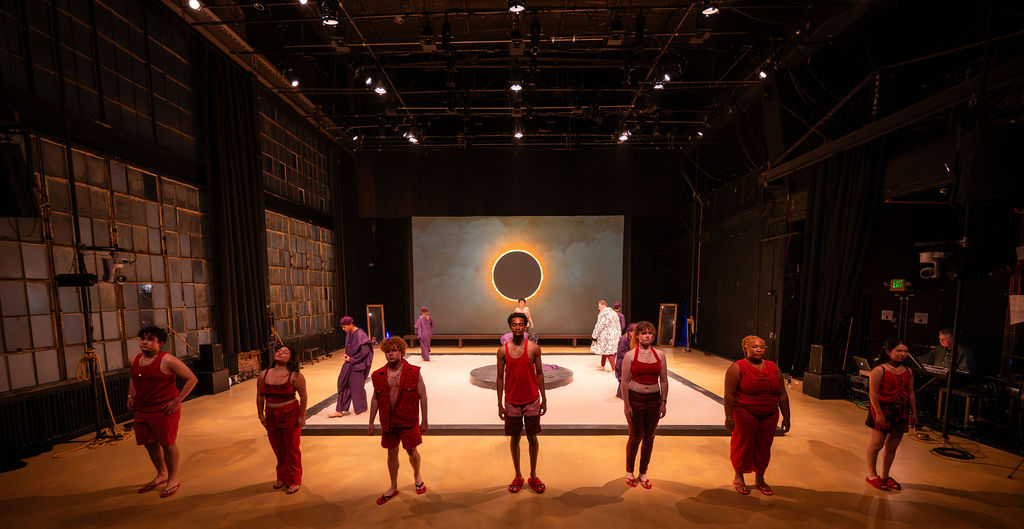
Stage design, gorgeous, the sand circle, the perpetual eclipse.
Costumes were sensational – very satisfying. Not only the way people were clothed; I noticed how often the men were unclothed, stripped naked from the waist up. Men who were young and gym-fit. Men who were young and not gym-fit. Men who were aging, whose flesh was soft, softer still, and softly melting. All pointing to themes of divestment, age, transformation. All pointing to our shared mortality, but especially to the mortal condition of even the most beautiful, the most mighty. We must dissolve in the end.
Fantastic performers – I especially enjoyed Dean Linnard, Tyler Aguallo, and Natalie Pasquinelli. Dina Zarif brought soul and warmth to her vocals, just right for Cordelia.
Amanda Moody
Jay Cloidt
Composer, Sound Designer, Dearest of Friends
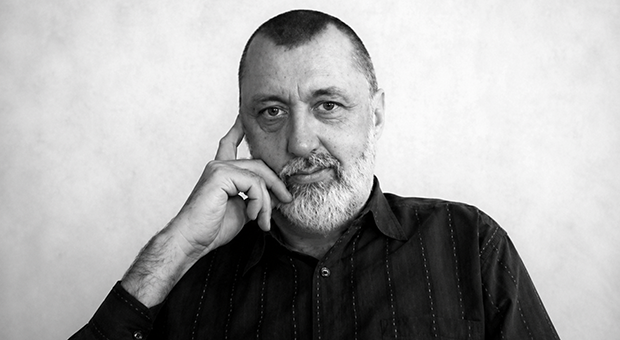
October 5, 1949 – April 17, 2026
Obituary by Paul Dresher, Philippa Kelly
Jay Cloidt lived a life filled with music—the kind that makes you think, laugh, and feel its visceral impact. He left this world in his sleep early in the morning of April 17th, but his playful, resonant music will echo long after.
Jay’s musical journey began with a classical foundation. He earned his BA in piano performance from the University of Nebraska–Lincoln, and his adventurous spirit soon led him out west. In 1977 he worked with Veronica Aiken at the Upstairs Art Association in Oakland, and she says of this collaboration, “We were real rebels back then.”
Jay’s friend Mark Dalton recalls: “Some of the best adventures Jay and I had together were as members of the Isaac Scott Band, including backing up the fabulous Albert Collins at Seattle’s after-hours nightclub, Hibble and Hyde’s, where the action was just warming up at 2 a.m. Playing the San Francisco Blues Festival in Golden Gate Park in 1978 was another high point, with Jay leaving a blood-streaked keyboard on the festival’s grand piano.”
Next up for Jay: Mills College Center for Contemporary Music. There, in 1981, he earned his MFA in Electronic Music and the Recording Media, under mentors Robert Ashley and David Behrman.
For those lucky enough to be in the San Francisco Bay Area, Jay was a sonic hero. As a sound designer and live sound engineer, he first worked with Paul Dresher, and the two continued their collaboration and deep friendship until Jay’s death. Jay was the invisible hand behind countless powerful live performances, designing and mixing live sound and touring the world with renowned organizations such as the Kronos Quartet, the Margaret Jenkins Dance Company, and the Paul Dresher Ensemble. He won a Bay Area Critics Circle Award for his work on the Paul Dresher Ensemble’s Slow Fire, and an Isadora Duncan Award for sound design on Rinde Eckert’s Dry Land Divine.
As a composer, Jay created music with a magical mix: technically sophisticated, yet brimming with warmth and humor. His commissions included works for Nancy Karp and Dancers, the Kronos Quartet, Margaret Jenkins Dance Company, Brenda Way/ODC Dance, and the Paul Dresher Ensemble. Joshua Kosman of the San Francisco Chronicle called him “The Spike Jones of the Bay Area new music scene.” Jay’s music traveled the world, including the Venice Biennale, New Music America, and Lincoln Center.
Jay’s spirit lives on in his recordings, especially his solo CD Kole Kat Krush, released by Starkland. The All-Music Guide, giving this piece a 4-star review, called it “a wonderful, accessible, and yet challenging album from one of new music’s brightest lights.” Stereophile agreed, giving it four stars and noting that Jay was “one of the few composers in the post-sampler era to fully develop that tool’s fascinating and witty potential.” Composer Carl Stone praised the album for its “skill, wit, perversity, and adroitness.” Starting in 1999, for nearly a decade Jay brought his playful genius to Leapfrog, creating sounds that sparked musical inventiveness in children.
Perhaps no night summed up Jay Cloidt better than October 20, 2017 at Berkeley’s Hertz Concert Hall with a retrospective concert celebrating the composer’s life in sound that also acknowledged Jay’s 8 years as the Audio Engineer for the UC Berkeley Music Department and the Center for New Music and Audio Technology (CNMAT). The audience heard everything from the majestic Sather Tower carillon to the tender intimacy of the Eco Ensemble String Quartet, from a solo piano piece to a hilarious and magical “duet for pianist and pian(o” with interactive electronics. And we heard the soaring, dramatic music from Jay’s theater work Darc: Woman on Fire, featuring a collaboration with Amanda Moody and Melissa Weaver to create a piece for singer and cello.
Jay Cloidt wasn’t just a composer and sound designer. He was a unique light, a dearly warm friend, and an acerbic wit who proved that music should always have a twinkle in its eye. He will be dearly missed, and we join his beloved wife Kathleen (who shares his unique blend of wit and compassion) in mourning him.
Jay also leaves behind his sister, Monica Vance, and nephew Matt Vance, both of Lincoln, Nebraska, and his Kennedy sisters-in-law and their children, all of whom treasured him. The final words for Jay’s fascinating, agile spirit can be left in the hands of one of his favorite bands, ABBA: “What a joy, what a life, what a chance!”
Jay Cloidt Faces 1965-1981-present
Memorial:
Saturday, September 26, 2026 at 2 PM
Dresher Ensemble Studio
2201 Poplar Street, Oakland